
Schoolcraft Projected and Actual Release
A projected date is a forward-looking calculation. It may mark when the Parole Board gains jurisdiction, when a sentence could reach its maximum, or a local estimate based on a jail judgment. An actual release date records that the person left a specific custodian. Those facts cannot be swapped. For a Michigan state prisoner, “Date Paroled” is historical. For a Schoolcraft County Jail booking, the jail's release entry records physical departure. A court order can authorize release before jail staff finish processing it.
Pretrial custody works differently. A person awaiting trial does not have a sentence-based exit date. Bond may be posted, a court may order recognizance release, charges may change, or another authority may lodge a hold. A detainer is a request or notice from another authority that can prevent a community release even after the local basis for custody ends. The MiCOURT docket can show a bond or court event, but the Schoolcraft County Jail remains the source for the actual release or transfer time.
The Schoolcraft County released inmates search explains how to obtain the local release entry when the question is about a completed event rather than a future date.
Find a Schoolcraft Projected Release Date
Start by identifying the custodian. OTIS is correct for a person serving a Michigan prison sentence or under MDOC supervision. It is not a Schoolcraft County Jail database. A county-jail-only sentence should be checked against the judgment and the jail's calculation. If the person is pretrial, focus on bond and court orders rather than trying to calculate a sentence date that does not exist.
- Determine whether the person is pretrial, serving a county jail sentence, or serving an MDOC prison sentence.
- For an MDOC prisoner, open OTIS and search by the six-digit MDOC number or commitment name.
- Match the person by birth date, sentence, court, and county. A photograph alone is not enough.
- Read Parole Board Jurisdiction Date, Maximum Date, Date Paroled, and Status together.
- For a county sentence, obtain the judgment through the Schoolcraft D93~2 court path and call the Schoolcraft County Jail at 906-341-2122 for its actual calculation and release entry.
- Recheck with the originating office near the date because later court, conduct, hold, or parole action may change the result.
The OTIS definitions page shows the state date labels and status codes used to interpret a Schoolcraft-related state prison record.
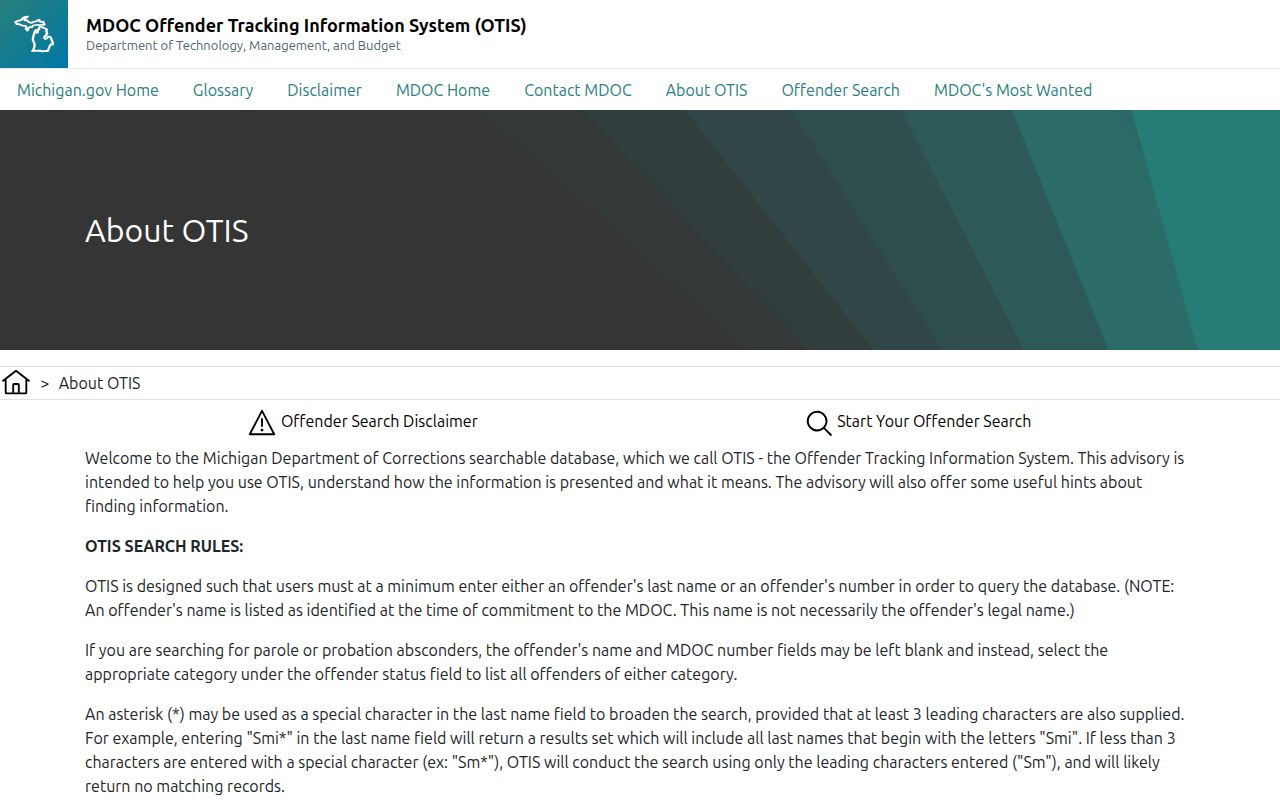
The definitions view makes the crucial split visible: the jurisdiction and maximum fields are prospective, while Date Paroled records an event that already happened.
| OTIS field | What it means | What it does not prove |
|---|---|---|
| Parole Board Jurisdiction Date | Eligibility point when Board jurisdiction may begin under the governing sentence | A promised release appointment |
| Maximum Date | Potential maximum endpoint under the applicable calculation | That parole will not occur sooner |
| Date Paroled | Historical date the person actually left prison on parole | That parole supervision has ended |
| Status | Context such as prisoner, PAROLE, PROB, or DISCHRG | The meaning of every date without the sentence record |
Note: OTIS generally excludes jail-only sentences, so a blank state search does not answer a Schoolcraft County Jail release-date question.
Schoolcraft Truth-in-Sentencing Release Rule
Michigan does not use a generic 85-percent shortcut for the covered cases described by MDOC. Under truth in sentencing, covered prisoners serve 100 percent of the judicial minimum in prison before parole consideration. The rule applies to specified assaultive crimes committed on or after December 15, 1998, and other covered crimes committed on or after December 15, 2000. It removed good-time and disciplinary credits against that minimum for those cases.
The MDOC truth-in-sentencing explanation is the controlling plain-language source for this Michigan computation rule.
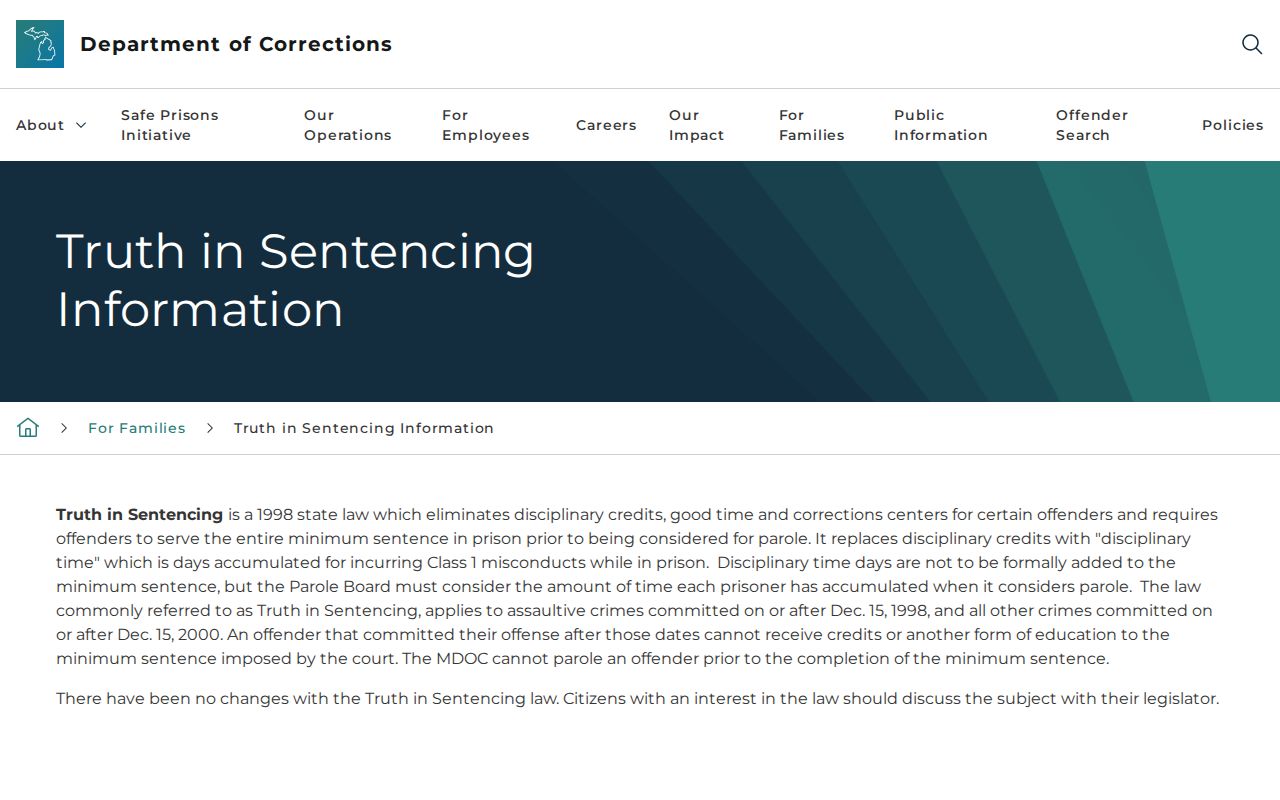
The state page confirms why the judicial minimum, Parole Board jurisdiction, and physical release must remain separate when reading a projected release date.
Michigan generally uses an indeterminate prison sentence. The judge imposes a minimum, while law supplies or governs a maximum. MCL 791.234 gives the Board jurisdiction after the applicable minimum, less credits where older law permits them. MCL 791.233 bars parole before the required minimum and sets the Board's release standard.
Class I misconduct can produce disciplinary time. MDOC says that time informs Board consideration but is not formally added to the judicial minimum. This nuance is why a simple percentage or hand calculation cannot replace the live sentence record and Board process.
Schoolcraft Legacy Release Credits
Older Michigan sentences can follow credit rules that do not apply to modern truth-in-sentencing cases. For legacy crimes after April 1, 1987 but before the relevant cutoff, the MDOC glossary describes disciplinary credits of five days per month, plus two more days for exceptionally good behavior. A major-misconduct month can lose seven days. The stated maximum is 84 days per year. These date-sensitive credits must not be placed on a modern covered sentence.
MCL 800.33 governs legacy good-time and disciplinary-credit categories. MCL 800.34 addresses disciplinary time. The offense date, controlling sentence, consecutive terms, and credit category all matter. A person may have more than one sentence with different rules, so the displayed dates and official computation are safer than applying one credit rate to the total term.
County jail calculations are separate. No official Schoolcraft-specific good-time rule, fixed weekend-release policy, or promise of Friday processing was found. Obtain the judgment and ask the jail how it calculated the term. After departure, use the Schoolcraft County FOIA form for the actual local release entry. Do not copy an MDOC prison date rule onto a county jail sentence.
Note: A legacy credit formula is relevant only when the offense date and governing law place that sentence in the older category.
Why Schoolcraft Release Dates Change
A projected release date can move or fail to become an actual release. Some changes begin in court. Others arise from the sentence structure, conduct record, Parole Board action, or release planning. The source of the change determines where to confirm it. A court controls its judgment, MDOC controls the state computation and custody record, and the Schoolcraft County Jail controls its local release and transfer entry.
| Factor | Possible effect | Best source |
|---|---|---|
| Amended judgment | Changes the sentence terms used in the calculation | Sentencing court and corrected MDOC record |
| Consecutive sentence | Adds a term that must be served in sequence | Judgment and MDOC sentence details |
| Legacy credits or misconduct | Changes an older-law calculation or Board assessment | MDOC sentence and conduct records |
| Parole denial or deferral | Leaves the person in prison beyond the eligibility point | Michigan Parole Board record |
| Suspended favorable decision | Stops planned release after new information | Board and Parole Release Unit |
| Hold or detainer | May cause transfer instead of community release | Holding and receiving agencies |
| Incomplete release plan | Delays physical departure after a favorable decision | MDOC Parole Release Unit |
A transfer date is not a community release date. If the Schoolcraft County Jail sends a person to MDOC, another county, federal custody, or immigration custody, the local jail stay ends but custody continues elsewhere. Ask for the release or disposition code and the receiving agency rather than relying on a bare departure date.
Errors also follow the source of the disputed fact. OTIS directs a person to the sentencing court for court-derived data, since MDOC changes that information after a court order. A mistaken parole, probation, or absconder entry belongs with the proper supervision office. If a state release date cannot be resolved from the public display, a focused MDOC request can seek nonexempt parts of the Basic Information Sheet, parole decision or order, actual release-date record, and discharge certificate. For a local term, the Schoolcraft judgment and jail release entry remain the relevant pair. This source-by-source approach prevents a future eligibility estimate from being confused with a completed release. It also creates a clear record of which office supplied each date and when that office last confirmed it. Keep the confirmation date with any saved result because later action may alter a projected field.
Schoolcraft Parole Decision Timing
Parole eligibility does not command release. The Michigan Parole Board considers the record and can grant, deny, or defer action. A grant moves the case to the Parole Release Unit for planning. A denial produces later reconsideration. A deferral delays action while information or placement work is developed. OTIS Parole Board Jurisdiction Date marks eligibility or jurisdiction, not the result of that review.
The official parole consideration process says at least 28 days must pass between a favorable release decision and physical departure.
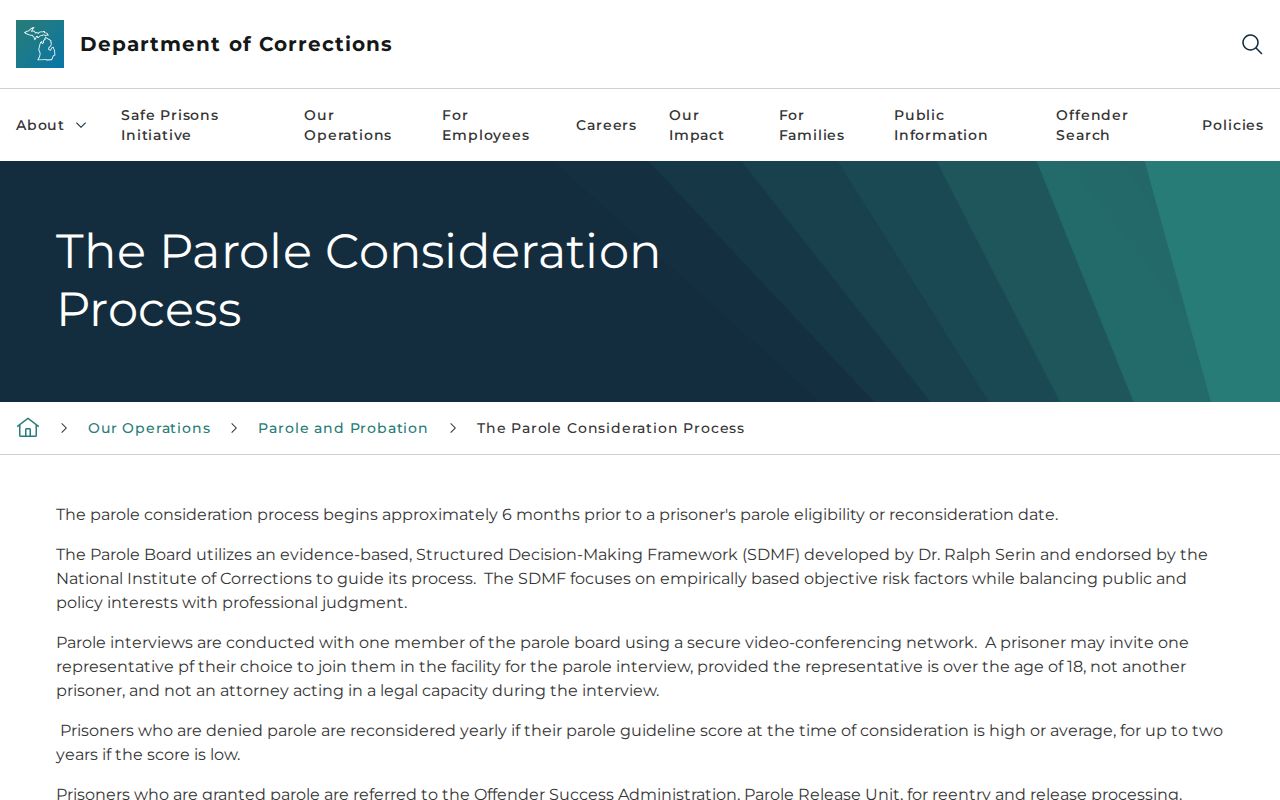
The process image shows why even a favorable decision must not be reported as the day the person left prison. Date Paroled or the release record supplies that endpoint.
Ordinary parole review often starts about six months before eligibility or reconsideration, but a public Schoolcraft County name-by-name calendar does not exist. Special public lifer and clemency hearings use a different schedule. For the individual case, use the Board record, OTIS dates, and the Schoolcraft supervision office after release.
Confirm Schoolcraft Actual Release
For a Schoolcraft County Jail term, call 906-341-2122 and request the actual release or transfer entry. Read the court judgment through the Schoolcraft court channel, but remember that an order may come before physical processing. A record with the release time, release code, and receiving agency can show whether the person entered the community or moved to another custodian.
For a state prisoner, compare OTIS Status with Date Paroled. If the public entry is unclear, request the nonexempt parole or discharge record from MDOC. DISCHRG means state jurisdiction ended for the displayed sentence, but the code alone does not establish a recent living prison release. “Date Paroled” has the narrower historical meaning.
MI-VINE may send a release or transfer alert for MDOC and participating local agencies. Schoolcraft County Jail participation should be checked in the live portal for the person at issue. Alert data is useful for speed, but it is not a certified release form and may describe departure from one agency before another receives the person. Registration details are available on the Schoolcraft VINELink inmate search.
Note: Recheck a projected date near the expected event because court, custody, and parole systems can update on different schedules.