
Verify Schoolcraft Post-Release Supervision
The first public check is the Michigan Department of Corrections Offender Tracking Information System, commonly called OTIS. Search by the six-digit MDOC number when it is known. A commitment name also works, but names can collide or change. Match the date of birth, sentence, court, and county before reading the status. A photograph can help, yet it should never be the sole match. OTIS covers people in Michigan prisons and people on active MDOC parole or qualifying felony probation. It does not cover a person whose only sentence was served in the Schoolcraft County Jail.
Read the status and dates as one record. PAROLE means the person left a Michigan prison and remains under parole supervision. PROB means active probation supervised by MDOC. DISCHRG means MDOC jurisdiction over the displayed sentence has ended. It does not, by itself, identify how the discharge occurred. “Date Paroled” is the stronger historical field because MDOC defines it as the date the person physically left prison. The Schoolcraft office can address a stale or unclear supervision entry.
- Open the live OTIS search and accept its terms.
- Enter the MDOC number or commitment name, then use age, status, or other fields to narrow the match.
- Compare identity, Schoolcraft court information, controlling sentence, and status. Do not rely on the photo alone.
- Read
PAROLE,PROB, orDISCHRGwith Date Paroled and the listed supervision location. - Contact the proper Schoolcraft office if the entry is stale, disputed, or too limited to confirm current supervision.
Schoolcraft Parole and Probation Differences
Parole and probation both permit a person to live outside prison under conditions, but the legal source is different. The Michigan Parole Board grants parole after a state prisoner becomes eligible. Probation is a court sentence. For a qualifying felony probation case, the sentencing court keeps legal jurisdiction while MDOC Field Operations provides day-to-day supervision. District-court probation is a separate local route and should not receive a state parole question merely because both offices supervise people in the community.
| Point | Parole | Probation |
|---|---|---|
| How it begins | Michigan Parole Board approves release from state prison | A court imposes a community sentence |
| Public OTIS status | PAROLE | PROB for MDOC-supervised probation |
| Legal authority | Michigan Parole Board and MDOC | The sentencing court, with the correct probation office |
| Key release field | Date Paroled shows prison departure | Judgment and probation order show the term |
| How it ends | Discharge from parole or maximum discharge | Court or MDOC discharge after the probation term |
Conditions are case-specific. At a high level, supervision can require reporting, approved residence or travel, treatment, payments ordered by the court, and compliance with the law. A suspected violation does not itself prove that supervision ended or that the person returned to custody. The agent, court record, and any warrant entry provide the needed context.
- Parole
- Conditional release from a Michigan prison under Parole Board authority.
- Probation
- A court sentence served in the community under stated conditions.
- Discharge
- The end of the agency's jurisdiction over the displayed sentence.
- Absconder
- A person who stopped reporting or otherwise left required supervision without authorization.
Note: A person on probation may never have served a state-prison term, so Date Paroled may not exist in that record.
Schoolcraft Supervision Office and Reentry
Schoolcraft County has a named MDOC parole and probation office. The state Region 1 directory is the best source for current routing because staff assignments can change. The county also publishes a local supervision department page, but the state directory should control when the two differ. No Schoolcraft-branded reentry center was found in the research. The verified broader service layer is MDOC's Offender Success Administration, which coordinates in-reach and community support for eligible people.
The Region 1 office directory shows the Schoolcraft supervision contact used for parole and MDOC felony probation questions.
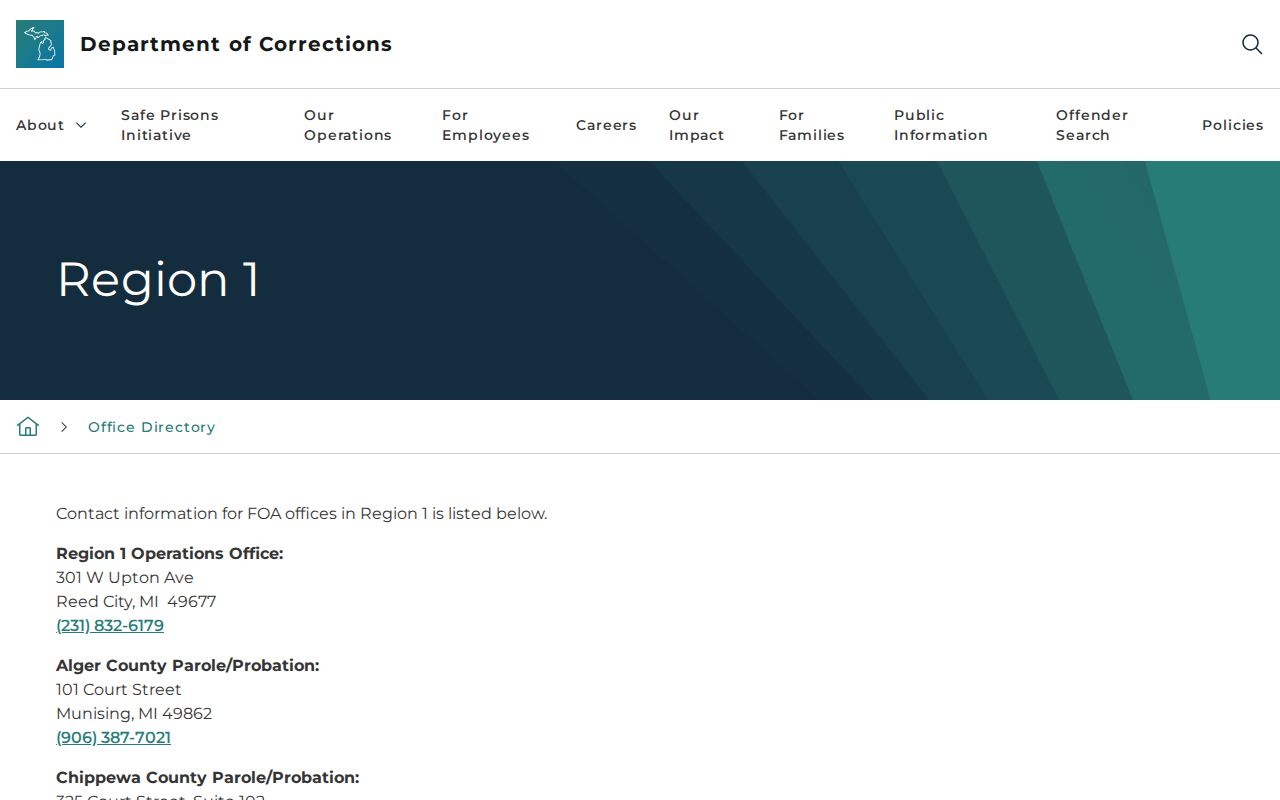
The directory view helps distinguish the Manistique state office from the separate district probation channel and gives a direct place to verify Schoolcraft post-release supervision.
MDOC Schoolcraft Office
300 Walnut Street, Room 208
Manistique, MI 49854
906-341-3682
93rd District Court Probation
District-level probation questions
Office: 906-341-3636
Cell: 906-202-5366
The statewide Offender Success Administration is the documented reentry contact layer. Eligibility and services depend on the individual case, so the existence of that program should not be read as proof that a named person receives a certain service.
Schoolcraft Parole Hearing and Release
The Michigan Parole Board is the sole paroling authority for felony offenders committed to MDOC. Most ordinary decisions are made by three-member panels. The process often starts about six months before an eligibility or reconsideration date, and an interview is generally held by secure video with one Board member. There is no public Schoolcraft County name-by-name calendar for ordinary parole interviews. Public schedules instead focus on exceptional lifer and clemency hearings.
A Board outcome may be a grant, denial, or deferral. A grant authorizes the case to move into release planning, but it is not proof of physical release. A denial leads to later reconsideration. A deferral puts off action while more information or placement work is developed. The official parole consideration process states that at least 28 days must pass between a favorable decision and departure from prison.
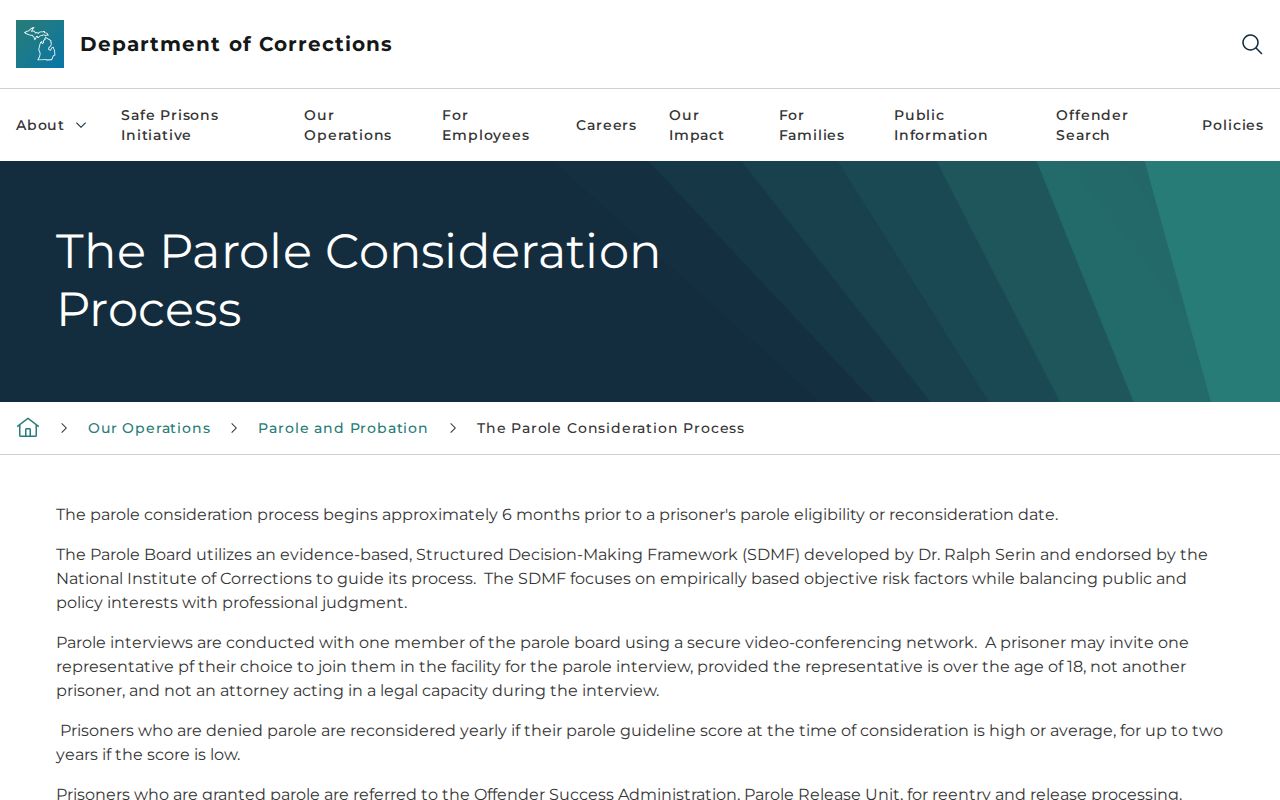
The process image reinforces why a grant date, eligibility date, and Date Paroled answer three different questions about a Schoolcraft County parole case.
For one person, OTIS Date Paroled or the actual parole record is more useful than an aggregate report. The Michigan Parole Board can be reached at 517-373-0270 or Parole-Board-Staff@michigan.gov. MCL 791.234 governs when Board jurisdiction begins, while MCL 791.233 supplies the release standard. Life sentences have special rules and should not be reduced to a general date formula. The Legislative Reports Archive publishes quarterly counts of grants, denials, and deferrals, guideline bands, and stated reasons. Those reports describe Board work statewide but cannot establish one Schoolcraft County person's outcome. Ordinary interview results require the individual record. Note: Ordinary parole interviews do not appear on a county calendar, and public lifer or clemency hearing listings serve a different process.
Correct Schoolcraft Supervision and Property Records
An error should go to the office that created the source data. OTIS directs court-derived errors to the sentencing court. A court order is generally needed before MDOC changes that information. Parole, probation, and absconder entries should go to the appropriate supervision office. This split keeps a Schoolcraft sentencing issue with the court while a current reporting or office assignment issue goes to Field Operations.
A county jail release record can answer a related practical question about property. Michigan's GS11 records schedule lists inmate release forms and property-release forms among the examples in a jail-inmate jacket. A narrow Schoolcraft County request may ask for both records while excluding medical material and unrelated private content. These records address release from the Schoolcraft County Jail. They do not replace an MDOC parole order or prove that state supervision ended.
The full local custody and record path appears on the Schoolcraft County released inmates search. Ask for the record tied to the specific booking, because a person can have more than one jail stay or supervision term.
Search Schoolcraft Absconder Status
OTIS has two distinct absconder codes. ABSCOND1 means a parole absconder actively sought by MDOC. ABSCOND2 identifies a probation absconder under the sentencing county's jurisdiction. OTIS permits a statewide status-only search even when no name or MDOC number is entered. That search can identify records carrying one of these codes, but identity and case details still need to be matched with care.
Absconding means failed supervision. It is not successful completion, discharge, or proof of present prison custody. A warrant or later arrest can return the person to custody, while the public status may update on a different schedule. For urgent public safety information, the MDOC contact page lists the Absconder/Escapee Tip Line at 517-755-0855. Current custody should then be checked with the agency that holds the person.
Schoolcraft Post-Release Supervision Discharge
Supervision ends through a formal discharge, not merely because a person stops appearing at an office or no longer reports on the old schedule. In OTIS, DISCHRG means MDOC no longer has jurisdiction for the sentence shown. That can follow completion of parole or probation, a maximum discharge, or another recorded reason. The code alone does not prove a recent prison exit. Date Paroled remains the historical prison-departure field.
Public OTIS visibility is also time-limited. MDOC generally displays discharged people for three years after the most recent supervision discharge. A set-aside or expungement can remove an entry sooner. Therefore, a blank search is not proof that a Schoolcraft County parole or probation term never existed. The sentencing court file or a focused MDOC records request may preserve the relevant disposition after the online window closes.
MI-VINE can provide status or notification data for MDOC and participating local agencies, but it is not a certified supervision discharge record. The Schoolcraft sheriff site does not promise live MI-VINE participation for every local booking. Use the originating office's record when the exact end date or legal basis matters.
Note: Record absence may reflect the three-year display limit or a lawful set-aside, so confirm an older term through its originating office.